The Art of Business
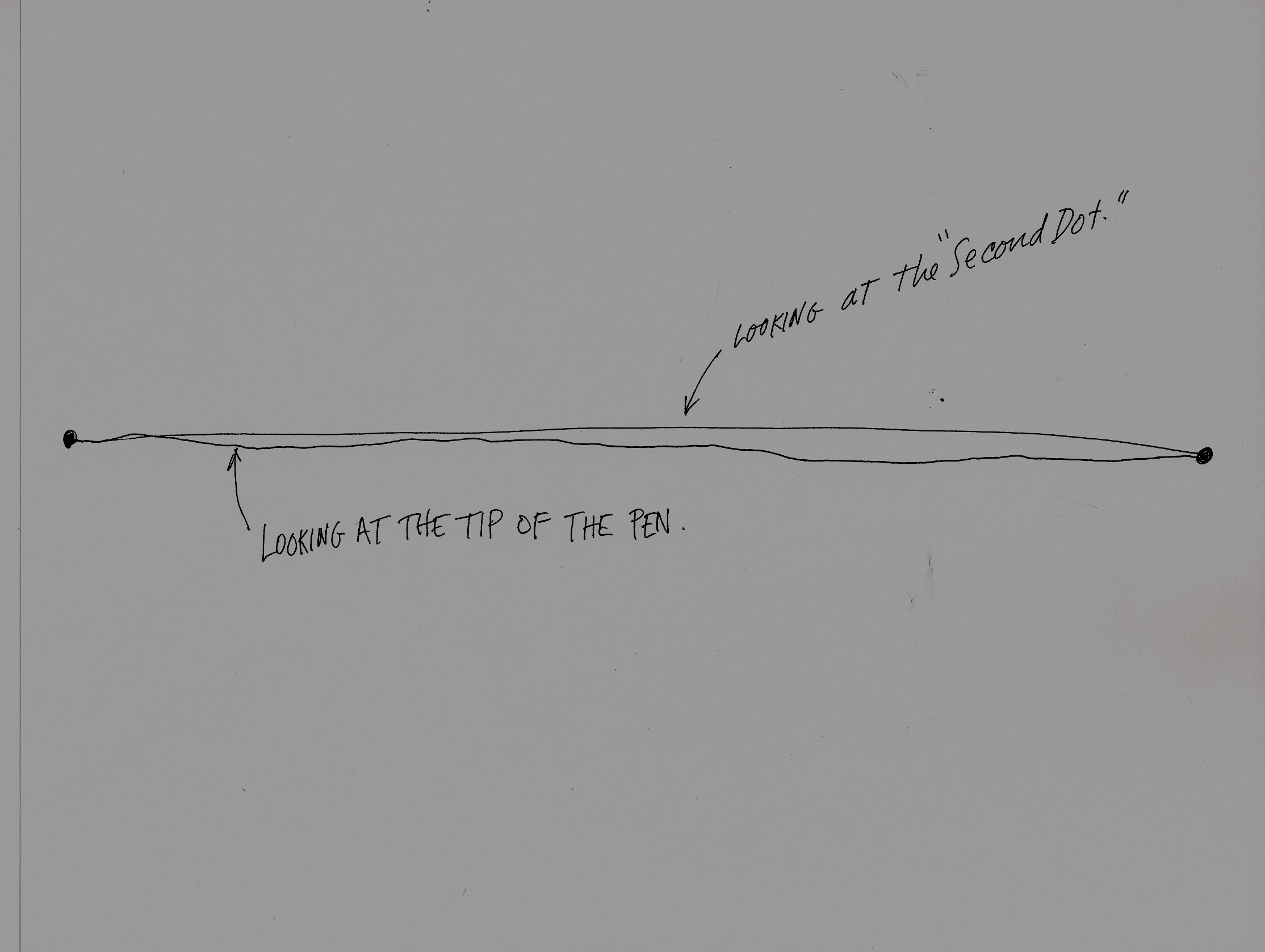
In college one of my drawing instructors took us through a simple exercise, and it was about vision. (Most people who don’t sketch think you draw with your hand…you don’t…you draw with your eyes.)
Here’s the exercise. Lay a piece of paper horizontally on your desk. Put a dot on the far left and another dot on the far right. Put your pencil on the first dot, stare at the tip of the pencil and carefully draw a straight line to the second dot. Ok, go back and do it again. But this time put your pencil on the first dot and stare at the second dot while you’re drawing the line. The second line will be straighter. (That’s mine above).
Drawing is like business; you need to stay focused on where you’re going. Most organizations right now are discussing or considering how to evolve. And while a lot of leadership groups are sitting around the table talking about what to do, it often goes nowhere. There’s the distractions of the day-to-day, pressing client needs, budget considerations…you know, the usual fires.
But if your organization seems to lack a sense of mission, you need to find the time to articulate and visualize your company’s “second dot”. To put a fixed point out into the future that defines what you want your business to become. Take the time to do this early, and you’ll get there faster. If you keep being distracted by the day-to-day of where you are now, you’re probably going to wander all over the place.

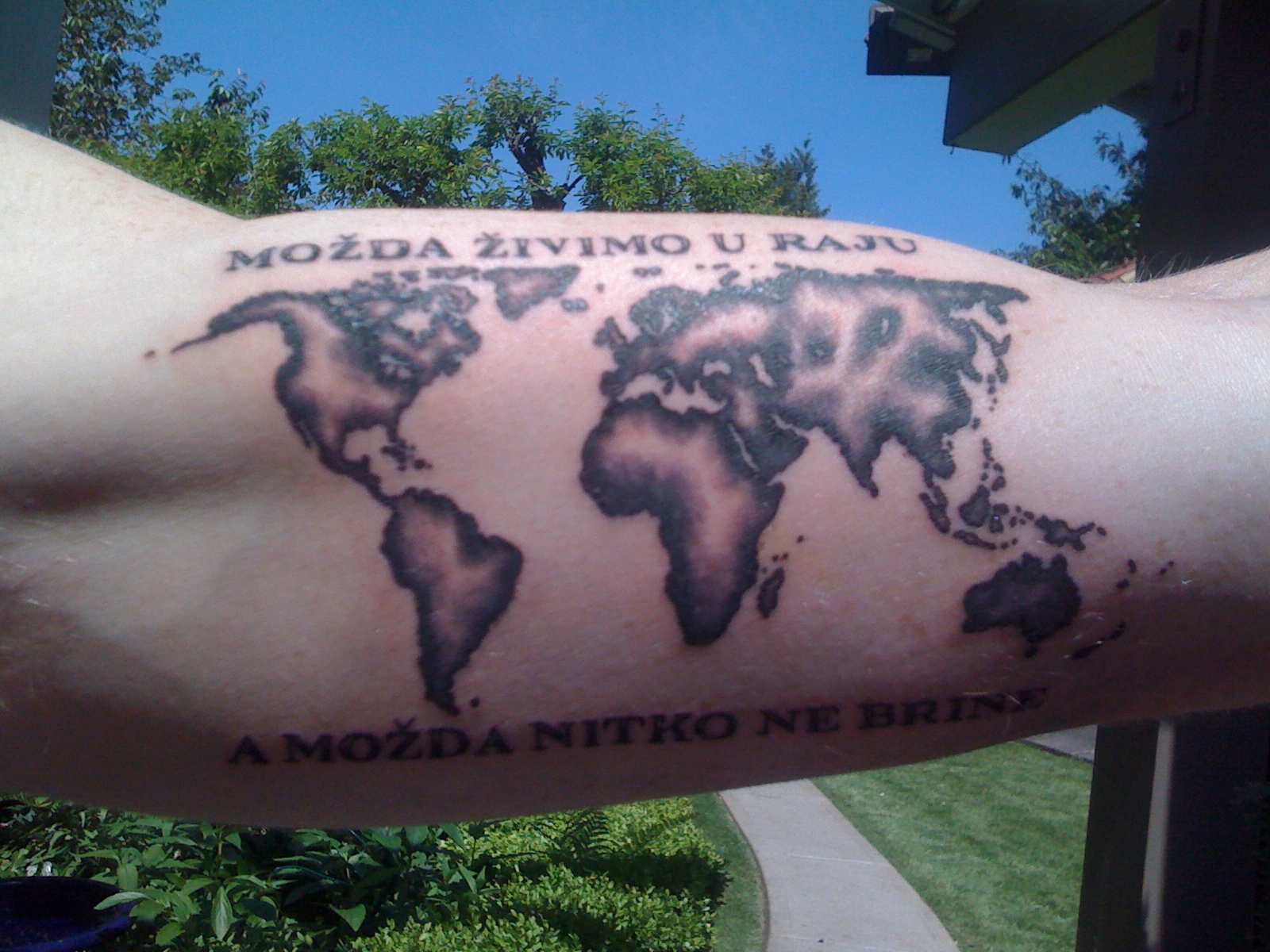
High in the mountains of Bosnia, in an old mortar bunker, my son noticed a message scratched into the stone. He was in the Balkans studying conflict and conflict resolution, and he wrote it down in his journal and made a sketch. He’s been carrying that sketch around for the last two years, deciding, “how important it was” to him.
I didn’t know about the sketch until he showed up with this tattoo on his arm. He’d obviously made his decision. (Fortunately he has a good eye for design and artists.) And unless you can read Bosnian, I’ll translate, “Perhaps we live in paradise and maybe no one cares.”
If you believe what you read lately, 56% of people are unhappy in their jobs. Usually an article about what companies should do to make their employees happier follows that fact. But happiness in organizations is a two way street. It’s also true that part of the responsibility to be happy rests with us. Abraham Lincoln put it another way, “Most folks are as happy as they make up their minds to be.” Old Abe probably could have related to that soldier in the bunker.
We live in a time of radical change. But chaos creates opportunity. So next time you’re frustrated, you may want to step back and think about why. Maybe you have more control over the situation than you think. Maybe you’re in paradise, and you’re just not bothering to care. It’s all a matter of perspective.
Last week was spent in Los Angeles meeting with some incredibly smart and talented people in the entertainment industry. My partners and I were lucky enough to be guided by David Stanley and Peter Dekom at Weissman Wolf in Beverly Hills. We met with Octagon, APA, 44 Blue, Holy Cow; and with Frank and Donna, friends at Radical Media.
The idea for our show got us into the meeting, but the discussion was about drama, conflict and voyeurism. The Story. Not the idea, the story. (David Liss has a great quote in an interview in the back of his book The Coffee Trader, he said, “My problem, frankly, isn’t getting the idea, it’s figuring out how to turn an idea into a story. That’s the hard part…”).
Obviously these elements are critical to any show to build an audience and attract a network, but it also made me think about how brands market themselves. The world of advertising is changing from “broadcasting” to “engaging” customers.” It also needs to change from “the big idea” to the “the big story.” Brands need to do more than change their media plan and add a little social media, they need to rethink how they tell their story.
If brands truly want to engage audiences, they need to ask, “Where’s the drama, conflict and voyeurism in my brand that will engage people.” Great brands are engaging stories. Coming up with ideas is easy. The hard part is turning them into great stories.

I spent last week on a road trip to Los Angeles and back. We visited family on the Oregon Coast, swung though San Luis Obispo to see our son, and relaxed at Avila Beach. Then we drove on down to Los Angeles for a couple days of meetings, a tour of the Mad Men set, and dinner with friends. On the way back, we reconnected at the Hopland Wine Festival with Jim and Ann who we hadn’t seen for years.
When my wife got her picture taken with Jon Hamm, the first thought I had was, “that picture is going on her Facebook.” And it made me think about how much more successful technology is when it connects with behavior from the real world. Facebook is like a road trip. Traveling to different places, reconnecting with old friends, and staying in touch with family and business colleagues. People have been doing it for centuries. Facebook just made it easier.
Unfortunately a lot of discussion about technology is about technology, not the people using the technology. New technologies that succeed understand the basic human behavior they facilitate and mimic. The emotional need they fill.
Ipad is another great example. A lot of technology experts spent a lot of time talking about its technological “limitations.” But people looked at it and thought, wow, I can just point at what I want, take it wherever I want, and wow, that’s really light.” (Which is the brilliance of the outdoor campaign for the Ipad, it communicates all that without a single word.)
Social media will never totally replace a road trip. But yes, posting the picture of Jon Hamm on her Facebook was the first thing my wife did when we got back from our trip.
Recently I was in Montana with some members of our special forces directing some interviews. They were there for additional training. But the training was not what I expected. They were there for ‘awareness’ training. Or as one called it, “Jedi Training.” They were there working on taking the one thing we all have, “instinct”, to the next level. Learning to trust, control and maintain what a lot of us call a sixth sense. A critical skill for anyone who is working on a mission in unknown territory and making critical choices. They we’re literally working on their ability to ‘see into the next room.” One of them gave this example, “I was at a fork in the trail, and something inside me says don’t go left, go right. The intel said they were both fine. The choice looked equal. But the “feeling” said go right. Later we learned the trail to left was heavily mined.”
Obviously, the stakes facing businesses and marketers are not quite as dramatic. But, the rapid changes that technology is creating in how businesses operate and market themselves, is forcing a lot of leaders to make important choices about their organizations. Trust your instincts. Pick a direction. Go with the force.
In early 2007, in my previous agency, we spent the next 10 months talking to our traditional and interactive agencies about integration. Some people stepped up and made the effort. Art Directors wandered over to talk to developers. Producers talked programmers. Sometimes the two groups even went to lunch together. But little changed. Progress was slow. Even when people know things need to change, actual change is hard. Why? Change is about working differently, learning new languages and skills, and embracing the unknown. And it scares most of us.
So after 10 months of talking about it, we had a meeting. And this is what we told everyone. We have two buses, the traditional bus and the interactive bus. And we’re going to create one bus. Since talking about it didn’t make it happen. Here’s what we’re going to do. We’re going to get the traditional bus and the interactive bus going at full speed and we’re going to crash them together. Some of you will jump before the collision, some will get thrown off the bus, but if you survive the collision, you’re not only going to end up on one bus, but in new seats. Better seats.
The result was some excitement, angst and gnashing of teeth. Some people left, but the talent that stayed and those that joined came because they wanted to be part of the future. And the initial results were spectacular. The micro site for American Airline’s new business class (www.theflagshipexperience.com) was the centerpiece of a worldwide launch that included print, television and on-line (the television came last). Texas Tourism brought home Mercury Awards for best tourism television and best overall program. And the digital team, with the help of our broadcast producers, turned a printed mailer into http://aadvantagemilestones.com/, a mixture of digital and film that gets better with every new episode.
So if you’re actually thinking about your business’s role in the future, you better quit talking about, and start making some changes. Put your ideas in action, not in a presentation. Crash the buses together.
If you’ve worked with me before, you’ve heard me talk about this. In a world that gets more complicated, with more moving parts and more choices and information, there is one thing that hasn’t changed. And that’s the size of the human head. We can only retain so much information, and for most most of us, it’s seems like it’s already full. (It’s why we can’t remember where we left our car keys).
So if that’s true, if you’re a marketer, what do you do? Your customers certainly don’t need a lot more information. They already have more than they can handle. You just have to ask one simple question. What is the Simple Human Truth about your business? Because if you want to get them to engage with you, you need to quit worrying about what you want them to know, and figure out why they should care. Because unlike our limited capacity for facts and details, we humans seem to have an unlimited capacity for emotions. You need to burn a whole in their head. Brands aren’t built on facts, they’re built on emotion.
You need to start with your Simple Human Truth.
During the launch of Wii, Nintendo gave us the assignment to relaunch GameBoySP. Since television advertising was being devoted to Wii, we created a campaign built around a microsite that introduced the different colors and designs in episodic videos. The launch increased sales by 70%, set an industry record by selling 1.3 units in a single week and won the Imedia award for most creative online digital marketing campaign.